Pages

06/02/2012

re-living room | day one

day one


Actions:
  • build wall
  • install floor


    Objects, materials and costs


    • Voucher for printing - £10.00
    • 2"x1"x8' x 8 - £16.64
    • oak effect laminate flooring - found
    • wallpapered wall panels - reclaimed from previous project
    • 6g x 40mm & 6g x 20mm screws - £5.44
    • socket and light switch = £4.36
    • the sentinel - £0.40

    03/02/2012

    re-living - terrain vague

    Terrain Vague - an idea dating back to man ray and 1920's france, is a characteristic feature present in the post-industrial city with large areas of emptied space,and an inescapable feeling of absence.

    definition - Empty, abandoned space in which a series of occurrences have taken place 

    man ray - terrain vague, 1929


    This great article by Matthew Beaumont on Artangel, focusing on Kameric and Sala's 1395 days without red transfers the idea to 20th century Balkans, and in particular the 4 year Siege of Sarajevo.


    Still from 1395 Days without Red, a film by Šejla Kamerić. From a project by Šejla Kamerić & Anri Sala in collaboration with Ari Benjamin Meyers

    re-living - mike kelley, mobile homestead

    Mike Kelley - Mobile Homestead


    The links with my ideas for re-living room are - disinvested city, abandoned/dilapidated housing, a reversal of journey - taking the living back to the vacated. The journey itself seemed important - a parade of Kelley's intent - a thrusting in the face of the artist's view of the post-industrial condition. I like the idea that the work allows for the creation of "a permanent dialogue with the community" - a boundary crosser between personal and public art.


    Mobile Homestead is a major new work by Mike Kelley. It's both a public sculpture and a private, personal architecture - based on the artist’s childhood home on Palmer Road in Westland, a neighbourhood which primarily housed workers for the Big Three auto makers: Ford, Chrysler and General Motors.
    On Saturday 25 September 2010, Mike Kelley’s Mobile Homestead made its maiden voyage from its new home in Midtown Detroit (on the grounds of MOCAD) to return to the “mother ship”, the original Kelley home in the suburbs.
    On its way down Michigan Avenue, one of Detroit’s main arteries and passageway to the western suburbs, the mobile home passed through some of the city’s most historic neighborhoods such as the old Irish area of Cork Town; Dearborn, the home of the Ford motor company, the Henry Ford Museum and Greenfield Village (Ford’s personal collection of homes and structures associated with great Americans such as Thomas Edison, the Wright Brothers and Rosa Parks); Inkster; Wayne (where Kelley attended Catholic school); and finally Westland where the former Kelley family home still stands.
    In a largely disinvested city with many abandoned houses and dilapidated buildings,Mobile Homestead enacts a reversal of the ‘white flight’ that took place in Detroit following the inner city race riots of the 1960s. It does so at a time when the city is exploring new options of renewal by assessing its singular post industrial conditions in an attempt to articulate a new model for American cities.
    The sculpture which almost exactly replicates the vernacular architecture of working class neighbourhoods in the American Midwest, brings the suburbs back into the city, and as it travels - on specific missions - the mobile home performs various kinds of community services, establishing a permanent dialogue with the community that houses it. Mike Kelley shot material for a video documentary that focuses on the people and communities who live and work along Michigan Avenue.
    Mobile Homestead is artist Mike Kelley’s first public art project anywhere and the first major permanent installation of his work in his hometown. This project is also the first commission by Artangel in the United States and has been produced with support from the LUMA Foundation and in collaboration with the Museum of Contemporary Art Detroit. The work is also the first contemporary artwork especially commissioned for the Midtown Neighborhood of Detroit.
    Mike Kelley: “Mobile Homestead covertly makes a distinction between public art and private art, between the notions that art functions for the social good, and that art addresses personal desires and concerns. Mobile Homestead does both: it is simultaneously geared toward community service and anti-social private sub-cultural activities. It has a public side and a secret side…”
    James Lingwood, Co-Director of Artangel: “Mobile Homestead exemplifies the long-term projects Artangel on occasion commits to making happen. It’s an ambitious project that needs a specific place, in this case the city of Detroit. As the project evolves, it’s our hope that the place will need the project too.”

    Luis Croquer, Director and Chief Curator, MOCAD: “We are thrilled to be collaborating with Mike Kelley, one of Detroit’s greatest artists and Artangel, on this ground breaking project for the city of Detroit. Mobile Homestead is a complex multi-layered work that questions notions of history, site, architecture and most of all expanded notions of sculpture.”

    01/02/2012

    93 balfour street - preparations

    Alongside reliving room and maybe at times overlapping, I'm starting a new project based around a last house standing I found earlier in the year.

    93 Balfour Street stands empty and alone almost as an anti-flag - a representative of what once was.

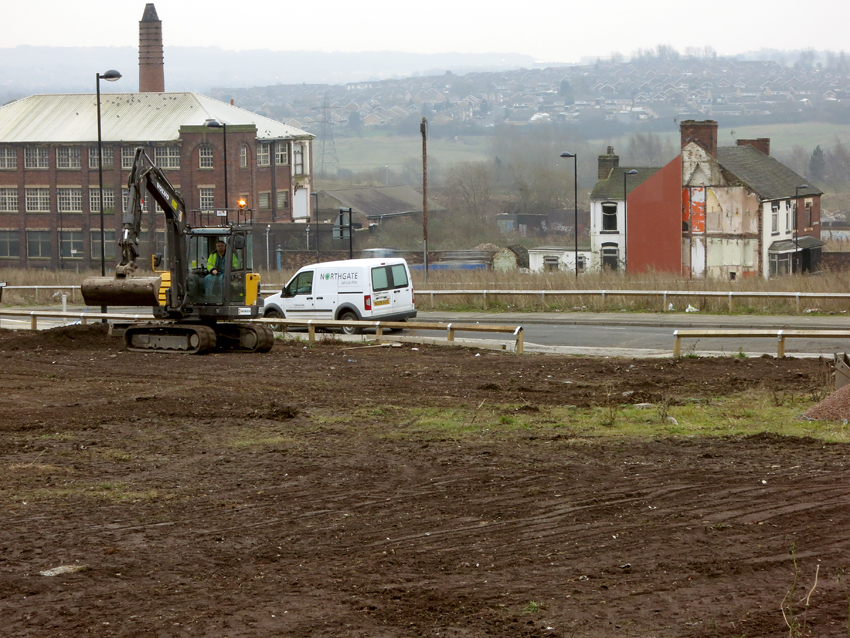
    To get there I walked east. I knew the area from a previous project, but Stoke Council must have unearthed a secret stash of funds, because all over the city, those emptied and neglected areas of former terrace houses are being ploughed over to give a smarter appearance, or maybe being readied for a more long-term land use.

    The Walk


    93 Balfour Street


    I returned to re-shoot 93 Balfour Street today - in 5x4 with some 1997 fuji provia. The conditions were different - bright sun all day, so fingers are crossed for a good result. All being well...

    I plan to make an A2 print, frame and hover mount it and then take the house on tour to find out what people thing of the subject, the photograph, photography in general, in fact anything people are urged to say about the photo. At the moment I have 3 distinct groups to target - the general public, artists and art gallery goers and arts academics.

    How are photographs received and how and what do they make us think? How are my photographs received and how and what do they make us think?

    26/01/2012

    re-living room - preparatory

    AirSpace Gallery have kindly offered me a 2 week spot in AirWindow, their gallery-front exhibition space, which is really exciting - opportunities to show work publicly in such a great position and within the realm of a renowned gallery are rare. It's going to offer me the possibility to start, and more importantly to test, a new piece of work. To realise it physically, rather than it just exist in my head.

    I'm planning to install a living room in the window space over the course of the 2 weeks, from building the walls to arranging the furniture to deciding on the pictures that will hang. Each day I plan to make a new intervention, add a new piece of the jigsaw, until eventually hopefully the piece is finished.

    The work follows on from a previous piece of work - belonging -  and I'm referencing the same areas of depopulated housing spaces (that were the setting for that work and that are prevalent in this city and i'm guessing all other post-industrial cities). So, there will be a series of connecting references to those spaces -at the moment I'm not certain what they will be - but I'm sure they'll become clear over the 2 weeks.

    After that I'm hoping to take the set on a tour of spaces around the city and install the set, or maybe new sets, in a non-gallery situation.

    For now though, preparations have begun, behind the scenes, and the first job is to work out the dimensions of, and how to build, the wall.


    I also plan to cost the project, so, every piece of expense will be logged.

    item no.1 - permanent marker £0.35


    25/01/2012

    space invaders

    they come round without asking and make themselves at home.


    belonging - part one

    After 3 months of intensive shooting, reviewing, printing, reviewing, shooting....I finally reached the end of the first part of this piece of work which looks at the idea that Place = Space + Inhabitation.

    The 40 photographs form a body of work which seeks to highlight what happens to residential spaces cleared by urban regenerators. Places are cleared, brick by brick, letting memories and stored occurences escape. The resulting spaces are then reclaimed by nature's invaders - urban flora which relentlessly and inevitably fill the void. The result is a new place or series of places inhabited by a new population.

    Place → Space → Place


    22/06/2011

    kiss me quick - it's the way i tell 'em


    Kiss Me Quick - A four day contemporary art exhibition. The theme is on the experience of the beach as a holiday maker and also referencing the historic role of Margate as a main destination for working people on vacation.


    from an early stage, my work was going to respond to this article i read on the guardian website back in february. a piece of work that is site and subject specific.


    the seaside is inextricably linked with music hall entertainment and in particular the stand up comedian who would keep thousands of holiday makers amused and entertained for weeks on end - probably telling the same jokes, but generating laughter, merriment and a good time from a willing audience.

    finding out that margate was a town in decline, i originally wanted to explore the idea of laughter in the face of adversity, and to use the joke shop as a backdrop for a film of locals telling jokes.


     Following on from the this way, that way film which looked at the way people give directions, i was interested in looking at how people look when they tell jokes.

    In the intervening 3 1/2 months between reading the guardian article and arriving at the Arlington Square arcade, the joke shop had moved - the arcade slated for demolition - bought by tesco and soon to be demolished to make way for a new 24 hour superstore and car park.

    This inevitably had an effect on my planned work - i'd planned to use the steady stream of joke shop shoppers as my interviewees and joke tellers - but now, with only one shop left open in the arcade - dave's hamburgers - i was faced with a shortage in raw material.

    I decided i'd carry out the interviews anyway - standing on the street and asking passersby to come into the arcade to tell their joke in front of the closed-down joke shop. as well as asking for the jokes, i sort of automatically started to ask people what their thoughts were about the impending tesco, as i started to realise that the work was going to end up being about the similarity with the abc cinema/tesco replacement in Stoke.

    it's interesting that the interviews didn't really work in the way i'd initially planned either, as i found those people who accepted the offer to tell me a joke ( i asked about 100 people in the course of the 6 hours i was there, with about 20 positive responses - mostly the reaction was "no, no way" or "I would , but now that you've asked, I can't remember any" were by and large shy and reticent about it.

    It quickly became apparent that this was the wrong methodology for what I wanted to achieve. I think that I would have to give people advance notice - to canvass people in advance and to film them in more controlled circumstances, if i really wanted to achieve that fine scrutiny of a particular human response.